Auckland flatbed towing: when should you ask?
Not every tow needs a flatbed. Learn when to ask about one, what vehicle details to share, and how Drive1 plans flatbed towing in Auckland.
Flatbed towing carries the vehicle on the truck deck instead of leaving wheels rolling on the road. It is worth asking about when the owner’s manual calls for all-wheel-off-ground transport, when the vehicle has low clearance, or when damage may stop it rolling or steering normally. The right loading plan still depends on the exact vehicle, its condition and access at the pickup point.
Drive1 Towing operates a lie-flat flatbed across Greater Auckland. This guide explains what to check before you call, what details help us assess the job, and why a vehicle’s own recovery instructions matter.
What changes with flatbed towing?
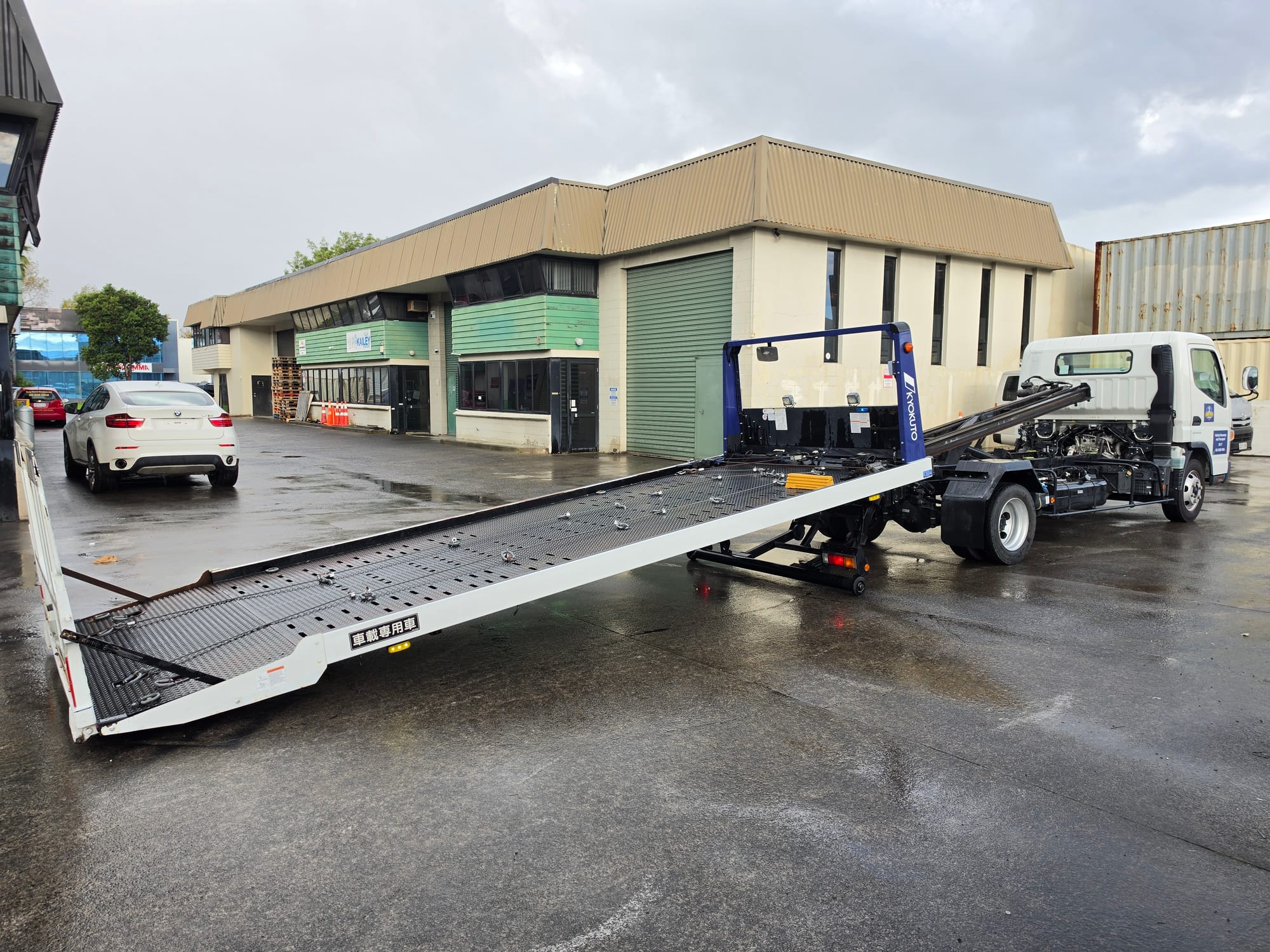
With a flatbed tow, the whole vehicle is loaded onto the deck for transport. Drive1’s deck can lie flat to help reduce clearance risk while loading low, lowered, sports and prestige vehicles. You can see the truck and real loading examples on our fleet page.
A flatbed is an option, not a universal rule for every breakdown. The vehicle manufacturer may specify a particular recovery method, and the pickup location may affect how the vehicle can be approached and loaded. That is why the first useful step is to identify the vehicle and describe its current condition.
When should you ask about a flatbed tow truck in Auckland?
Ask the dispatcher to assess a flatbed when one or more of these situations applies:
- The owner’s manual says the vehicle must be carried with all wheels off the ground.
- The car is lowered, modified or has limited ground clearance.
- Accident or mechanical damage may prevent the wheels, steering or brakes from moving normally.
- The vehicle is in a basement, tight driveway or another location where access needs checking.
- You are arranging a planned vehicle move and want the transport method confirmed before pickup.
These points do not replace the manufacturer’s instructions. They help the towing operator ask the right questions before choosing a loading method.
Check the vehicle manual, especially for an EV
Do not assume that every electric, all-wheel-drive or prestige vehicle uses the same recovery procedure. Check the towing or transport section of the owner’s manual for the exact model.
For example, Tesla’s current Model 3 transport instructions recommend a flatbed truck or comparable transport vehicle. The same manual describes an alternative using a wheel lift and dollies so that all four wheels remain off the ground. It also gives model-specific steps for Tow Mode and loading. Read the Tesla Model 3 instructions for transporters before trying to move that model.
Other makes and models can have different instructions. If you have the manual or a screenshot of its recovery section, send it with the vehicle details. Drive1 can then discuss the pickup using information for the actual car rather than a general assumption.
What should you tell the towing operator?
Clear information helps the operator assess access, loading and the quote before dispatch. Send:
- The pickup location and destination.
- The make, model and year.
- Whether the vehicle is electric, hybrid, all-wheel drive, lowered or modified.
- What happened and whether the vehicle can roll, steer and select neutral.
- Any visible accident damage, flat tyres or locked wheels.
- Whether the vehicle is on the street, in a driveway, in a carpark or underground.
- Whether keys and pickup authorisation will be available.
- A clear photo of the vehicle and the space around it, when safe to take one.
For a scheduled move, our vehicle transport pickup checklist covers the same information in more detail.
How is an Auckland flatbed towing quote worked out?
Drive1 uses quote-based pricing. The quote depends on the pickup and delivery distance, vehicle type, vehicle condition, access and timing. A car that rolls and steers at an open kerb is a different loading job from a damaged vehicle in an underground carpark.
Share the details above when you call or use the form. This gives Drive1 a clearer picture of the job and reduces the chance that important access or vehicle information is discovered only after arrival. We do not publish a flat rate because every tow has different conditions.
You can review the confirmed flatbed and low-vehicle service details on the services page.
If the vehicle is stopped in a dangerous place
Personal safety comes before deciding which truck to request. AA New Zealand’s breakdown safety guide advises drivers to move as far left as possible when they can do so safely, switch on hazard lights, and choose the safest place for occupants to wait. Call 111 if life is at immediate risk, or *555 when there is danger that is not life-threatening.
Once you are in a safer position, tell the dispatcher the road, direction of travel and nearest exit or landmark. Do not step into live traffic to inspect the car or take photos.
Ask Drive1 about the right loading plan
Drive1 provides flatbed towing for low-clearance, lowered, sports, prestige and electric vehicles, along with breakdown and accident recovery across Greater Auckland. Out-of-Auckland vehicle transport can be arranged by appointment.
Call 021 0289 7845 and describe the vehicle, its condition, pickup point and destination. For a written enquiry, use the quote form. We will assess the information you provide and discuss the suitable next step for that job.
24/7 towing across Greater Auckland.
Direct dispatch from Wairau Valley. Lie-flat flatbed for low and prestige vehicles. English & 中文.
- Car Park Recovery
Underground car park towing in Auckland: what to send
Car stuck in an underground Auckland car park? Send the entrance height, level, access route and vehicle condition before towing is arranged.
- Vehicle Transport
Auckland vehicle transport pickup checklist
Booking vehicle transport in Auckland? Prepare the route, access, keys and vehicle details needed for a clearer quote and a smoother pickup.
- Accident Towing
Accident towing in Auckland: what happens after a crash
Just had a crash in Auckland? The legal must-dos, who tows your car, where it should go, and how to keep control of costs, from a local accident towing crew.